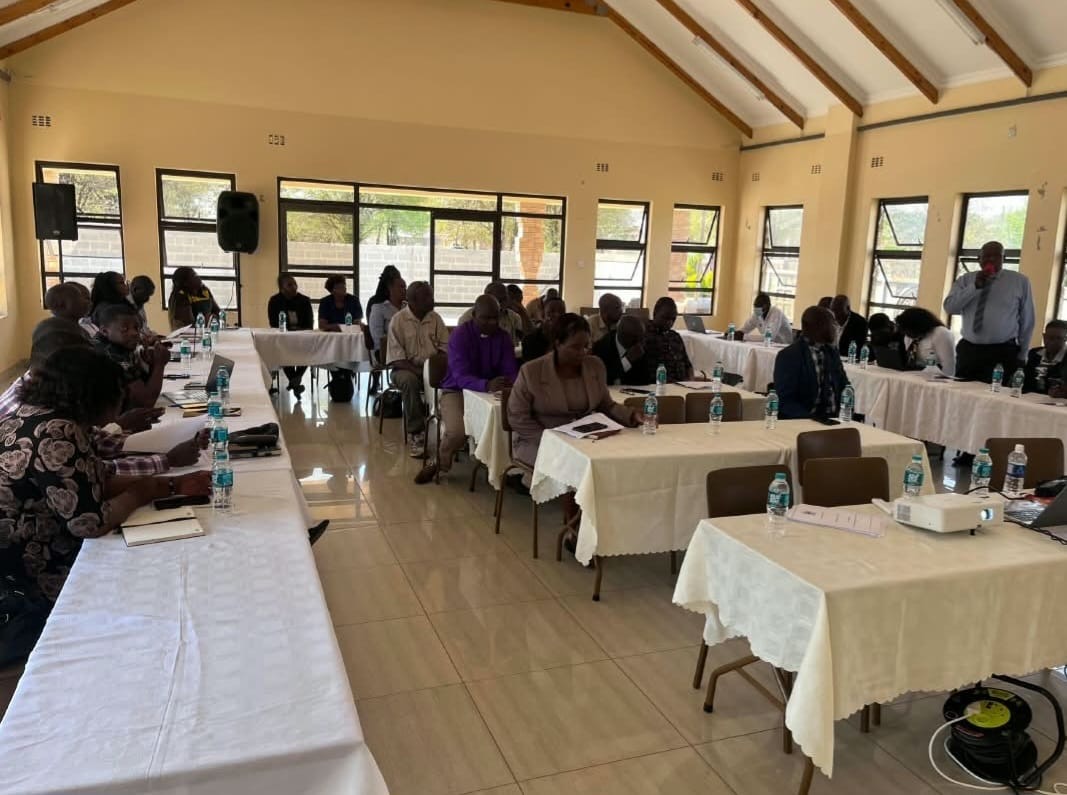
The Office of the Minister of State for Provincial Affairs and Devolution for Matabeleland South Province hosted the Private Sector Stakeholder Consultation Workshop for the Provincial Economic Development Plan (PEDP) 2026–2030 at Mt Cazalet Lodge in Gwanda.
The workshop was convened within the overarching framework of Vision 2030, the National Development Strategy and the Devolution and Decentralisation Agenda, with the objective of developing a practical and inclusive economic development blueprint for Matabeleland South Province.
The engagement brought together provincial leadership, local authorities, members of the Provincial Development Committee (PDC), regulatory bodies and captains of industry from the private sector.
Among those in attendance were the Minister of State for Provincial Affairs and Devolution, Hon. A. Nguluvhe; Secretary for Provincial Affairs and Devolution, Mrs L.L. Dhlamini-Maseko; Director Economic Affairs and Investment, Mr R. Ncube; Director Finance, Administration and Human Resources, Mr E. Mandeya; Acting Director Coordination, Ms S. Ndlovu; Deputy Director Business Development, Mr T. Mudzviti; Ms L. Vundla; Mr T. Godzi; Mr M. Ndukwana; Mr S. Muyambi; officials from Government departments and agencies; local authorities; and representatives of the private sector.
2. OPENING REMARKS
In her opening remarks, the Secretary for Provincial Affairs and Devolution, Mrs L.L. Dhlamini-Maseko, outlined the strategic vision for Matabeleland South's economic growth between 2026 and 2030.
She highlighted the Province's significant economic endowments, including livestock, citrus production, gold, lithium, solar energy resources and the strategic Beitbridge Border Post.
The Secretary stressed that natural resource endowments alone cannot deliver the desired economic transformation without deliberate coordination between Government, local authorities and the private sector.
The consultation was therefore intended to identify key provincial economic drivers, address regulatory and infrastructure bottlenecks, align local authority development programmes with private-sector investment, and ensure that MSMEs, women and young people are integrated into productive value and supply chains.
Guided by the national philosophy “Ilizwe Lakhiwa Ngabanikazi Balo” and the principle of leaving no one and no place behind, the Secretary emphasised that Government must provide an enabling environment while the private sector plays a central role in investment, employment creation and sustainable wealth generation.
3. OBJECTIVES OF THE WORKSHOP
Director Economic Affairs and Investment, Mr R. Ncube, outlined the key objectives of the consultation. These included providing a clear picture of provincial economic performance and future growth aspirations; developing the fundamental thematic components of the PEDP; identifying priority development projects unique to Matabeleland South; establishing private-sector investment commitments; defining provincial ease-of-doing-business targets; and aligning Government policies with private-sector development interventions.
4. KEYNOTE ADDRESS BY THE MINISTER OF STATE
In my keynote address, I emphasised that the workshop represented an important milestone in the socio-economic development of Matabeleland South Province.
I underscored that Devolution has strengthened the Province's responsibility to identify and harness its competitive advantages, while development itself remains a collective responsibility involving Government, local authorities, development partners, communities and the private sector.
Matabeleland South possesses considerable strategic advantages which, when properly harnessed, can position the Province as an important regional economic hub.
Particular emphasis was placed on the following economic pillars:
Trade and Logistics: The Province should leverage the strategic importance of the Beitbridge Border Post and Plumtree corridor to progressively transform itself from predominantly a transit route into a centre for logistics, manufacturing and value addition. Investment opportunities include logistics parks, dry ports, bonded warehouses and related infrastructure.
Agriculture and Livestock: The Province should commercialise its beef and goat value chains, strengthen cold-chain infrastructure, expand irrigation development and capitalise on opportunities in citrus and other high-value crops.
Mining and Beneficiation: Matabeleland South's gold, lithium, nickel and industrial mineral resources should increasingly support local beneficiation and value addition rather than reliance on raw mineral extraction. Greater local processing has the potential to retain more economic value and create employment within our districts.
Renewable Energy: The Province's abundant solar resource presents substantial opportunities for Independent Power Producer investments capable of supporting local industrialisation while contributing power to the national grid.
I further stressed that the PEDP must not become an academic document that remains on shelves. It must serve as a practical investment and implementation blueprint, clearly identifying projects, responsibilities, investment requirements, timelines and measurable economic outcomes.
The Province must continue improving the ease of doing business, prioritising strategic infrastructure through mechanisms including Public-Private Partnerships, and creating opportunities for MSMEs, women and youth-led enterprises to participate meaningfully in established corporate supply chains.
The development of the Province must remain inclusive. Everyone who lives, invests and conducts legitimate business in Matabeleland South forms part of our economic ecosystem and has a role to play in building the Province.
5. PROVINCIAL ECONOMIC BASELINE AND 2030 TARGETS
Mr K. Bembe presented the Province's economic baseline, historical performance and proposed trajectory towards 2030.
The presentation indicated that provincial GDP at market prices increased from approximately US$1.33 billion in 2020 to US$2.14 billion in 2024, with economic growth of 2.4% recorded in 2024.
6. Provincial GDP per capita increased from approximately US 2,798 in 2024, providing a baseline towards the proposed 2030 target of at least US$4,200 per capita.
The 2022 Population and Housing Census baseline placed the provincial population at 760,345, with estimates presented at the workshop indicating a population of approximately 777,165 by 2024.
Employment remained an area requiring particular attention, with the presentation indicating a decline from 43.3% in late 2022 to 29.6% by the second quarter of 2025.
The 2025–2030 outlook therefore seeks progressively higher economic growth, a stable macro-economic environment and recovery of the provincial employment rate towards a target of 55% by 2030.
7. SECTORAL CONSULTATIONS
Participants subsequently broke into sector-specific working groups to identify existing strengths, constraints, investment opportunities and priority interventions.
Mining and Mineral Processing: Participants recognised the Province's extensive mineral resources while identifying environmental degradation, land-use conflicts and delays in statutory approvals as major constraints. Priority interventions include local mineral beneficiation, formalisation of artisanal mining activities and strengthened environmental compliance.
Agriculture, Livestock and Agro-Processing: The Province's strong livestock base, wheat production and citrus potential were highlighted. Key challenges include recurrent droughts, animal disease-control constraints and inadequate post-harvest and value-addition infrastructure. Proposed interventions include irrigation rehabilitation and expansion, borehole and piped-water development, livestock genetic improvement programmes, abattoirs and cold-chain infrastructure.
Energy and Infrastructure: Participants identified Matabeleland South's high solar irradiation as a significant investment opportunity. The Province will seek greater participation by Independent Power Producers, particularly in solar generation, while exploring PPPs for critical transport and economic infrastructure.
Industry, Manufacturing and Commerce: The Province's location along international trade corridors provides a strong platform for industrialisation. Proposed interventions include development of Special Economic Zones, dry ports, bonded warehouses, processing facilities and import-substitution industries.
MSMEs, Informal Sector and Tourism: Discussions highlighted opportunities presented by cultural heritage, local crafts, tourism and horticultural value chains. Priority attention will be given to access to finance, formal market infrastructure and integration of MSMEs, women and youth-owned businesses into established value chains.
Investment Incentives and Ease of Doing Business: Stakeholders raised concerns regarding administrative delays, municipal licensing requirements and lengthy statutory approval processes. Proposed interventions include streamlined licensing procedures, appropriate investment incentives, accelerated land-application processes and greater security and predictability for investors.
8. KEY OUTCOMES AND WAY FORWARD
The workshop concluded with a commitment to translate the consultation outcomes into an implementable 2026–2030 Provincial Economic Development Blueprint.
The Secretariat was tasked with consolidating submissions from the sectoral working groups and incorporating priority projects, private-sector commitments, investment requirements and proposed policy interventions into the final PEDP.
Going forward, the Province will place particular emphasis on:
Developing bankable and investment-ready projects;
Strengthening Public-Private Partnerships;
Improving the provincial ease-of-doing-business environment;
Accelerating infrastructure development;
Promoting local mineral and agricultural value addition;
Expanding renewable energy investment;
Integrating MSMEs, women and youth into mainstream economic value chains; and
Establishing clear implementation, monitoring and accountability mechanisms for the PEDP.
9. CONCLUSION
In his closing remarks, Director Finance, Administration and Human Resources, Mr E. Mandeya, standing in for the Secretary for Provincial Affairs and Devolution, thanked all stakeholders for their active participation and valuable contributions.
The success of the Provincial Economic Development Plan will ultimately be measured not by the quality of the document produced, but by projects implemented, businesses established and expanded, jobs created, incomes improved and communities transformed across all districts of Matabeleland South.
The Province therefore calls upon Government institutions, local authorities, the private sector, development partners and communities to sustain the spirit of collaboration demonstrated during this consultation.
Our task is to convert Matabeleland South's abundant natural resources, strategic geographic position and human capital into tangible and inclusive economic prosperity.
Together, we must build a competitive, industrialised, investment-friendly and resilient Matabeleland South Province as we advance towards Vision 2030.