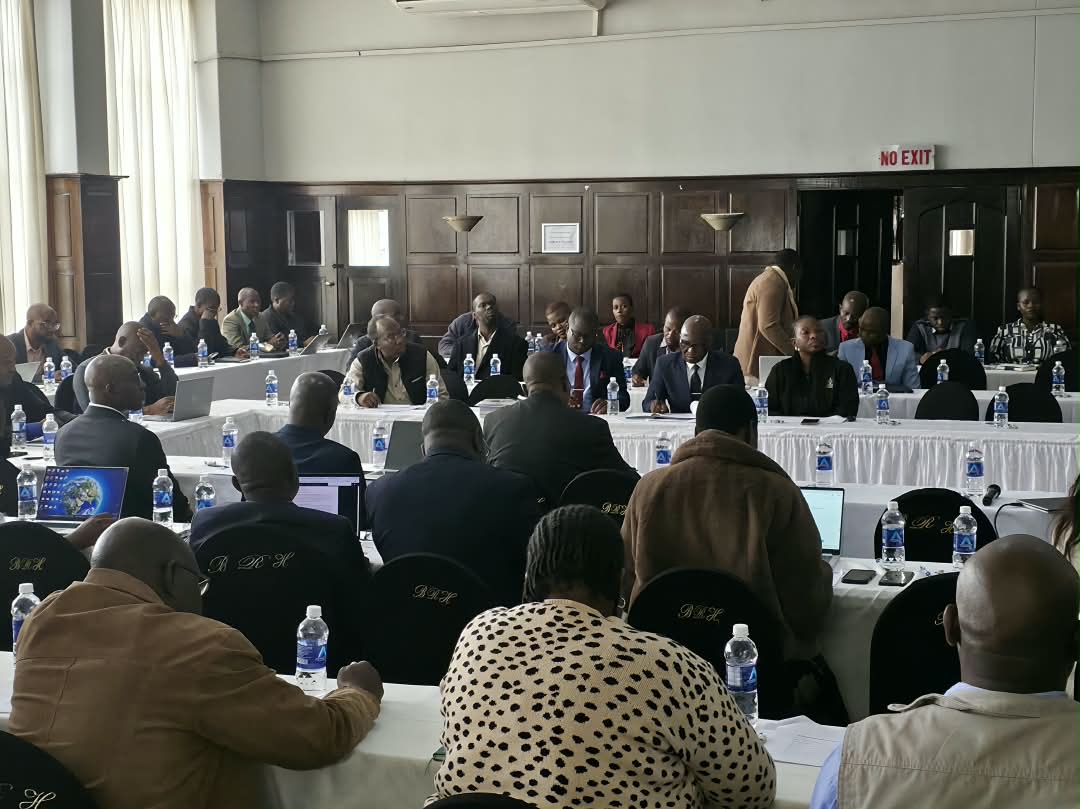
The Minister of State for Provincial Affairs and Devolution for Matabeleland South Province and Member of Parliament for Beitbridge East Constituency, Hon. Albert Nguluvhe, yesterday officially opened the formulation workshop for the Matabeleland South Provincial Economic Development Plan 2 (PEDP 2: 2026–2030) at Rainbow Hotel in Bulawayo.
The workshop is aimed at developing a practical and results-oriented provincial economic blueprint aligned with National Development Strategy 2 (NDS 2) and the national aspiration of attaining an empowered and prosperous upper-middle-income society by 2030.
Hon. Nguluvhe was accompanied by the Secretary for Provincial Affairs and Devolution, Mrs L.L. Dhlamini-Maseko; Director Economic Affairs and Investment, Mr R. Ncube; Director Infrastructure Planning and Environmental Management, Mr D. Njowa; and Acting Director Coordination, Ms S. Ndlovu; Ms S. Mabidi
Also in attendance were Acting Chief Director from the Office of the President and Cabinet Head Office, Mr C.M. Mujajati; Mr N. Bobo; Provincial Development Committee members; representatives of the private sector; Government ministries, departments and agencies; local authorities; development partners and other key stakeholders.
Delivering the keynote address, Hon. Nguluvhe said Matabeleland South had recorded notable economic progress under NDS 1, with the provincial economy growing from approximately US$1.33 billion in 2020 to US$2.14 billion in 2024.
Under PEDP 2, the Province is targeting an economy of approximately US$3.485 billion by 2030, a per capita GDP of US$4,200, a 55% gainful employment rate, and inflation below 5%.
The Minister stressed that achieving these targets requires the Province to accelerate its transition from predominantly exporting primary commodities towards value addition, beneficiation, industrialisation and employment creation.
Key priorities identified include expanding lithium beneficiation, developing cement and fertilizer manufacturing plants, establishing cold-chain agro-industrial hubs, strengthening climate-smart Village Business Units, expanding renewable energy and solar mini-grids, and improving strategic transport and water infrastructure.
The Province will also seek to leverage the strategic position of Beitbridge and Plumtree border posts to promote trade, investment and economic activity under the African Continental Free Trade Area framework.
Human capital development will remain central, including the completion of 41 legacy science laboratories and expansion of Technical and Vocational Education and Training testing facilities across all seven districts.
The Minister further highlighted the importance of completing strategic water infrastructure, including Tuli Manyange Dam, to strengthen agriculture, food security and climate resilience.
“Our focus must be on turning the abundant natural resources of Matabeleland South into industries, employment, incomes and improved livelihoods for our people. Our Provincial Economic Development Plan must therefore contain clear, measurable and bankable interventions capable of transforming the Province,” said Hon. Nguluvhe.
He acknowledged challenges affecting provincial development, including high levels of informal employment, limited access to affordable capital, duplication of local licensing requirements and recurring droughts.
Earlier, Mrs Dhlamini-Maseko described Matabeleland South as Zimbabwe’s southern gateway to the SADC region, endowed with significant mineral resources, livestock and horticultural potential, strategic cross-border infrastructure, high solar-energy potential and an industrious population.
She called upon stakeholders to transform the Province's situational analyses into actionable and bankable programmes, with particular attention to mineral beneficiation, renewable energy, infrastructure development, agriculture, formalisation of MSMEs and responsible artisanal mining.
Presenting technical guidelines, Mr C.M. Mujajati outlined the institutional and operational framework for PEDP formulation, emphasising alignment with NDS 2, Integrated Results-Based Management and Vision 2030.
Seven Provincial Thematic Working Groups have been constituted to develop interventions covering economic transformation; infrastructure and housing; food and climate security; technology and human capital; employment, youth and culture; devolution and decentralisation; and social development and protection.
Among the major economic opportunities highlighted during the workshop were approximately 5,180 hectares of citrus and pecan nut plantations, 25 revitalised irrigation schemes covering 1,535 hectares, 235 Village Business Units, and the integration of green energy into 15 macro-irrigation schemes.
The Province is also building on significant mineral and industrial production potential, including limestone, lithium and coal, alongside investments in lithium processing, cement production and fertilizer manufacturing.
Hon. Nguluvhe called upon Government departments, local authorities, the private sector, development partners and communities to ensure that PEDP 2 becomes an implementation-driven development plan rather than merely a policy document.
The workshop now proceeds into thematic breakaway sessions where stakeholders will develop and refine Provincial Development Matrices, including interventions, funding mechanisms, performance indicators, baselines and annual targets for 2026–2030.
Hon. Nguluvhe officially declared the PEDP 2 formulation workshop open, reaffirming the Province's commitment to inclusive and sustainable development guided by the national philosophy:
“Nyika Inovakwa Nevene Vayo / Ilizwe Lakhiwa Ngabanikazi Balo.”